Definition of Khula in Islam
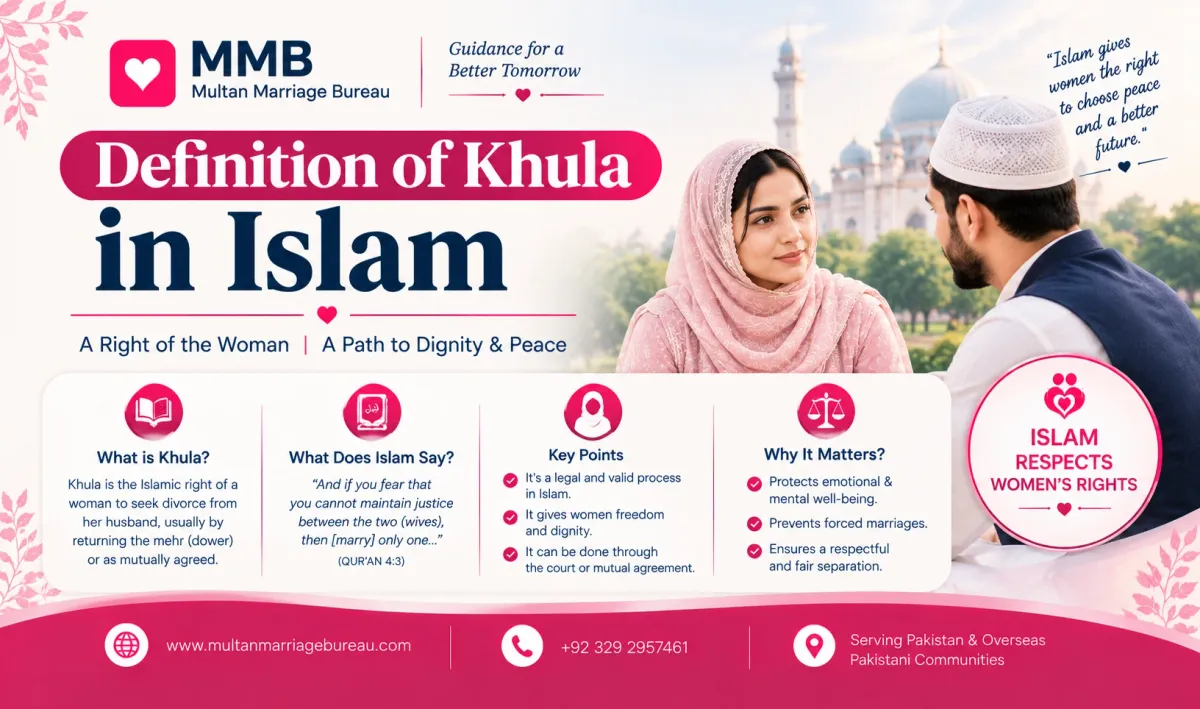
Definition of Khula in Islam: Meaning, Basis & Legal Process
Where khula comes from in the Quran and Hadith, how it differs from talaq, and exactly how the process works under current Pakistani family law.
Khula comes up often in conversations about marriage, sometimes with real confusion about what it actually means, how it differs from talaq, and what the process involves in Pakistan today. This guide lays out both halves clearly: the Islamic basis for khula from the Quran and Hadith, and the current legal procedure through Pakistan's Family Courts, including recent Supreme Court rulings that have shaped how it works in practice.
What Khula Means
Khula (خلع) is the Islamic legal mechanism through which a wife can seek to end her marriage, generally by returning her mahr (dower) or offering the husband some other agreed compensation. It stands in contrast to talaq, which is the husband's prerogative to pronounce, and to mubaraat, which is a mutual, no-fault separation agreed by both spouses.
Where Khula Comes From
The basis for khula is generally traced to Surah Al-Baqarah (2:229) in the Quran, which addresses a wife giving something back to her husband in exchange for her release from the marriage. It is further grounded in the hadith of the wife of Thabit ibn Qais, who came to the Prophet ﷺ saying she found no fault in her husband's character or faith but could not continue living with him. The Prophet ﷺ asked if she would return the orchard Thabit had given her as mahr; she agreed, and the separation was granted. This account, recorded in Sahih al-Bukhari, is the foundational precedent scholars point to when discussing khula.
Khula vs Talaq vs Mubaraat vs Faskh
| Type | Who Initiates | Compensation Involved? | Husband's Agreement Needed? |
|---|---|---|---|
| Talaq | Husband | No | N/A — his own pronouncement |
| Khula | Wife | Generally yes (mahr or agreed amount) | Traditionally yes; in Pakistan, court can grant it regardless |
| Mubaraat | Both spouses, by mutual agreement | Often none, or as mutually agreed | Yes — it's inherently mutual |
| Faskh (judicial annulment) | Wife, through a court/qazi | No | No — granted on legal grounds like cruelty or desertion |
Scholars across the major schools of Islamic jurisprudence agree khula is valid, but differ on some technical points — for instance, whether it should be counted as a talaq (affecting how many divorces a couple has used) or treated as a separate annulment (faskh) that doesn't count toward that limit. This is a genuine area of scholarly difference, and a knowledgeable local scholar can advise on which view applies to your specific situation and school of thought.
How Khula Works Under Pakistani Law Today
In Pakistan, khula is governed primarily by the Dissolution of Muslim Marriages Act 1939, the Muslim Family Laws Ordinance 1961, and the Family Courts Act 1964, with procedure refined by the Family Courts (Amendment) Act 2015. Only a Family Court can grant a khula decree — a Union Council cannot issue one directly, though it processes the divorce certificate afterward.
The Legal Process, Step by Step
- Attempt reconciliation first — involving family elders before filing is generally recommended and viewed favorably by courts, even though it isn't strictly mandatory.
- Send a formal legal notice — a lawyer typically sends written notice to the husband stating the intention to seek khula, which sometimes prompts an out-of-court settlement.
- File the petition — the suit is filed in the Family Court with jurisdiction over the wife's current residence, stating the facts of the marriage and willingness to return the mahr.
- Court summons and reconciliation attempt — the husband is summoned and given a chance to respond; the court then makes its own attempt at reconciliation before proceeding.
- Decree and Union Council processing — once granted, the decree is submitted to the relevant Union Council, which processes the formal divorce certificate needed for NADRA records and any future remarriage.
Cases commonly take a few months to resolve depending on the court's workload and whether the husband contests the petition, though timelines vary and shouldn't be treated as guaranteed.
Rights & Practical Considerations
Mahr (Dower)
Khula generally involves returning the mahr received, though courts retain discretion to waive this in specific circumstances, such as documented abuse or where the mahr was never actually paid.
Iddat Period
After khula is finalized, the wife typically observes an iddat of about three menstrual cycles, during which she is entitled to maintenance and cannot remarry.
Child Custody
Custody is assessed separately under the Guardian and Wards Act 1890, based on the child's best interests, and can be addressed within the same petition if needed.
Child Maintenance
The father generally remains responsible for child maintenance (nafaqah) regardless of how the khula case concludes.
Filing for Khula From Abroad
Overseas Pakistani women can generally pursue khula without returning to Pakistan, typically by executing a Special Power of Attorney (SPA) authorizing a lawyer or trusted representative to act on their behalf. The SPA usually needs attestation and, once received in Pakistan, further counter-attestation through the Ministry of Foreign Affairs before the case can proceed. Many Family Courts now also support statements and evidence submitted via video call through the e-court system, which can be particularly useful for cases involving overseas Pakistanis.
Thoughtful Matchmaking Reduces Uncertainty Later
Understanding rights and expectations clearly from the start helps both families enter a marriage with fewer misunderstandings down the road.
Register Your ProfileCommon Misconceptions
"Khula requires proving the husband did something wrong."
Not necessarily. Under Pakistani law, a wife can be granted khula simply by stating she cannot continue the marriage within Islamic limits — she isn't required to prove specific fault, though evidence of mistreatment can still matter for other financial claims.
"A Union Council can grant khula directly."
Only a Family Court can issue a khula decree. The Union Council's role comes afterward, in processing the divorce certificate.
"Khula and talaq are legally identical."
They share the outcome of ending a marriage, but differ in who initiates them, whether compensation is involved, and how scholars classify them within Islamic law.
Frequently Asked Questions
What is khula in simple terms?
Khula is the Islamic mechanism by which a wife can seek to end her marriage, typically by returning her mahr (dower) or offering compensation, as opposed to talaq, which is initiated by the husband.
Is khula mentioned in the Quran?
Yes. Surah Al-Baqarah (2:229) refers to a wife giving something back to her husband in exchange for release from the marriage, which scholars have long taken as the Quranic basis for khula.
Does a husband have to agree to khula?
Under Pakistani law, no. Courts have repeatedly held that a Family Court can grant khula even without the husband's consent, once reconciliation has failed and the wife maintains she cannot continue the marriage within Islamic limits.
Does the wife always have to return her mahr for khula?
Typically yes, since khula traditionally involves the wife returning her mahr or another agreed amount. However, Pakistani courts have discretion to waive this requirement in certain circumstances, such as documented abuse or where the mahr was never actually paid.
Is khula the same as talaq?
No. Talaq is initiated by the husband and does not require the wife to return anything. Khula is initiated by the wife and generally involves returning the mahr or an agreed compensation. Scholars differ on whether khula legally counts as a talaq or as a separate annulment (faskh).
How long does the khula process take in Pakistan?
Typically a few months, often cited around three to six months depending on the Family Court's workload and whether the case is contested, though timelines vary by case and location.
What is the iddat period after khula?
After khula is finalized, the wife generally observes an iddat (waiting period) of about three menstrual cycles, during which she is entitled to maintenance and cannot remarry, partly to confirm she is not pregnant.
Can overseas Pakistani women file for khula from abroad?
Yes, typically through a Special Power of Attorney authorizing a lawyer or trusted representative in Pakistan to act on her behalf, with the case proceeding through the relevant Family Court.
Does khula affect child custody?
Custody is decided separately based on the child's best interests under the Guardian and Wards Act, 1890, though it can be addressed within the same petition. The father generally remains responsible for child maintenance regardless of the khula outcome.
Is a Union Council certificate enough, or is a court decree required?
A khula requires a Family Court decree; it is not something a Union Council can issue directly. After the court grants khula, the decree is submitted to the relevant Union Council to process the formal divorce certificate.
An Established Right, Grounded in Clear Sources
Khula has a clear basis in Islamic tradition and a well-defined, evolving legal process in Pakistan today. Whether you're researching it out of general interest or navigating a real situation, the most reliable next step is the same: a qualified family lawyer for the legal process, and a knowledgeable religious scholar for questions specific to your school of thought.
For families earlier in the marriage process, our guide to marriage profile registration covers how to start that journey with clarity and honesty from day one.