Marriage Profile Registration
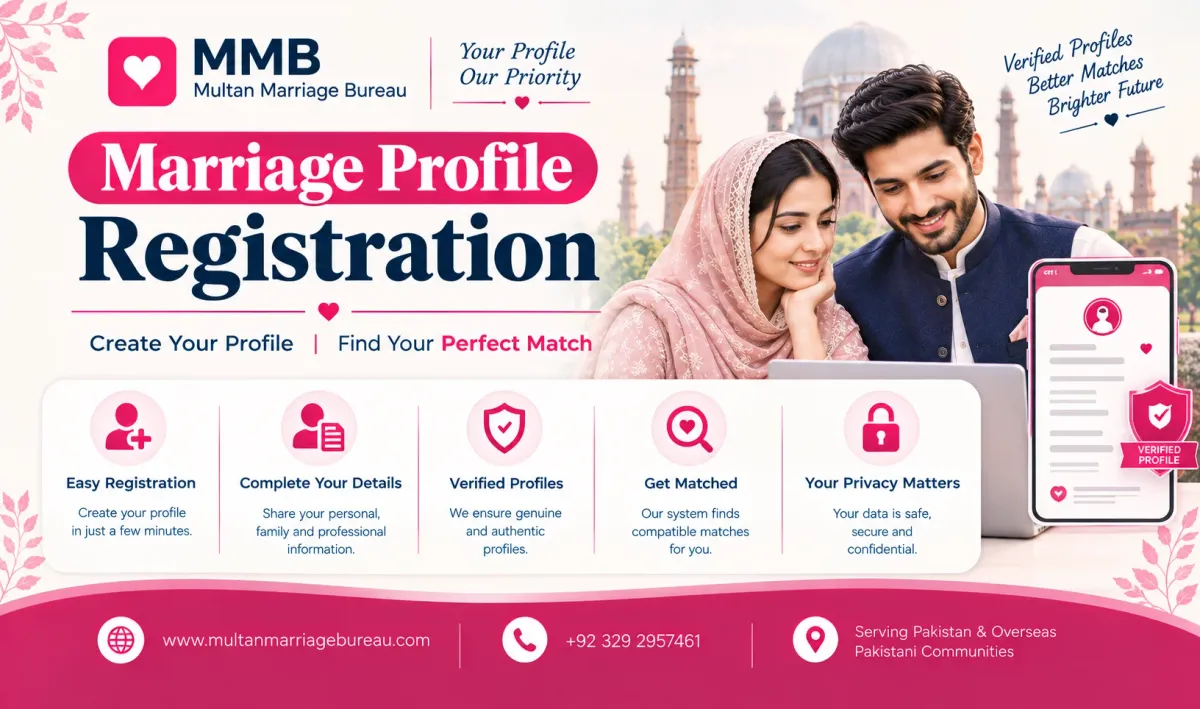
Marriage Profile Registration: A Step-by-Step Guide
Documents to prepare, how to actually write a biodata that works, photo guidelines, privacy settings, and the small mistakes that quietly slow the whole process down.
Registering a marriage profile sounds simple until you're actually filling out the form — how much detail is too much, what photo actually works, whether to mention a past engagement, how specific to be about salary. Small decisions at this stage shape how well a matchmaker can actually help you, so this guide walks through each part concretely: what to prepare, how to write it, and the mistakes that quietly cost people good matches.
What Marriage Profile Registration Actually Involves
At its core, registering a profile means submitting three things to a bureau or matchmaker: your personal and family biodata, a recent photograph, and a clear statement of your preferences for a match. What happens after that — verification, matching, and confidential sharing — depends on the bureau, but the quality of what you submit at this stage directly affects how well it works.
The Registration Process, Step by Step
- Gather your basic details first — have your personal details, education, profession, and family background ready before you start, so you're not filling gaps in later.
- Write your biodata — organize it clearly under simple headings: personal details, education, profession, family background, and preferences.
- Choose your photo carefully — pick something recent and clear, not a heavily edited or years-old picture.
- Submit to your matchmaker — a proper bureau will review what you've submitted and may reach out with a few clarifying questions before your profile becomes active for matching.
- Clarify your privacy preferences — confirm with the matchmaker exactly who will see your profile and under what conditions, before it's shared anywhere.
- Stay responsive after registering — profiles that get regular follow-up and quick responses tend to move through the process faster than ones left untouched for weeks.
What to Prepare Before You Register
Usually Needed
- Recent photograph, clear and well-lit
- Full name, date of birth, and city of residence
- Education and profession summary
- Family background summary
Good to Have Ready
- A short personal description ("About Me")
- Clear preferences for a match
- Any specific family or cultural preferences worth mentioning upfront
- A general sense of your availability for calls or meetings
Most bureaus keep initial registration simple and don't ask for official documents like your CNIC upfront — that level of detail is typically only needed later, once a match is confirmed and the family-to-family conversation moves forward.
How to Actually Write a Strong Biodata
A biodata isn't a CV, and it isn't a personal essay either — it's a clear, honest snapshot that helps a matchmaker and another family understand who you are quickly. Here's a simple structure that works well:
Personal Details
- Full name, date of birth, height, city of residence
- Sect/religious school of thought, if relevant to your matching preferences
Education
- Highest qualification, institution, field of study
Profession
- Current role, industry, and general work location
Family Background
- Father's and mother's profession (or retired status), number of siblings, general family values
About Me
- Three or four honest sentences on personality and lifestyle — specific, not generic ("enjoys reading and quiet evenings" beats "family-oriented and caring")
Preferences
- Age range, education level, and the two or three things that matter most to you in a match
Photo Guidelines That Actually Matter
Do
- Use a photo taken within the last year
- Choose good natural lighting
- Show your face clearly, front-facing
Avoid
- Heavy filters or edited images
- Group photos where you're hard to identify
- Photos more than two or three years old
The goal is simple: the person who eventually meets you in person should recognize you from the photo. Mismatches here create an awkward first impression that's entirely avoidable.
We'll Help You Get the Details Right
Our matchmakers review every submission and will guide you if anything needs adjusting before your profile goes live.
Register Your Marriage ProfilePrivacy Settings You Should Actually Confirm
Before you submit anything, ask the bureau directly:
| Question to Ask | Why It Matters |
|---|---|
| Who sees my profile, and when? | Confirms whether sharing requires mutual interest first |
| Is my phone number ever shared directly? | Protects you from unsolicited contact |
| Can I request my profile be removed later? | Gives you control if you pause or stop the process |
| Is my data stored securely? | Basic protection against misuse or leaks |
Common Registration Mistakes
Inflating details
Exaggerated education, income, or age tends to surface later during family discussions, and undoes trust right when it matters most.
An outdated or unclear photo
This creates avoidable awkwardness once families actually meet.
Vague "about me" sections
Generic phrases like "family-oriented" or "caring nature" tell a matchmaker almost nothing useful — specific details help far more.
Overly rigid preferences
A long list of strict requirements narrows your pool more than most people realize, often without improving compatibility.
Going quiet after registering
Profiles that don't respond to follow-up tend to fall behind more responsive ones in a matchmaker's priorities.
Honesty in Your Biodata Matters — Islamically and Practically
Islamic guidance places real weight on honesty between prospective spouses and their families, and a biodata is very much part of that. Misrepresenting age, marital history, or personal circumstances isn't just a practical risk — it runs against the spirit of transparency the process is meant to have from the very beginning.
This matters at the legal stage too: details on your biodata should match what eventually appears on the Nikah Nama and other registration documents. Our guide to the definition of khula in Islam is also worth reading if you want a fuller picture of how honesty and expectations connect to the marriage process overall.
Registering From Abroad
The core information needed doesn't change much for overseas Pakistanis, but the process usually adapts in a few ways: identity verification often happens over video call instead of in person, and consultations are scheduled around your time zone.
We regularly support registration for families across the UK and USA, as well as Canada, Australia, and Germany, with the same verification standards used for clients based in Pakistan.
Frequently Asked Questions
What documents do I need to register a marriage profile?
Registration usually just needs a recent photograph and basic written details covering your education, profession, family background, and preferences. Official documents like a CNIC or degree copy typically aren't needed until later, once a specific match is being seriously considered.
How long should a marriage biodata be?
A clear, well-organized one to two pages is generally enough. Longer isn't necessarily better — a biodata that's easy to scan and covers the essentials clearly is more useful to a matchmaker than one padded with excessive detail.
What should I avoid including in a marriage profile?
Avoid overly personal financial details, exact home addresses, and information about other family members that isn't relevant to the match itself. Keep contact details limited to what the bureau needs, not what gets shared publicly.
Is it okay to exaggerate details on a marriage biodata?
No. Inaccurate details about age, education, profession, or marital history tend to surface during family discussions or the Nikah documentation stage, and can seriously damage trust between families at exactly the wrong moment.
What makes a good profile photo for a marriage biodata?
A recent, clear, well-lit photo showing your face plainly, without heavy filters or outdated images, works best. It should look like you, not an idealized version of you, since mismatches are quickly noticed once families meet.
How is my information kept private after registering?
With a properly run bureau, your profile should only be shared with families who've expressed genuine, mutual interest, not posted publicly or distributed without your consent. Ask directly how this works before registering.
Can I update my profile after registering?
Yes, most bureaus allow you to revise your preferences or biodata as the process continues, since priorities sometimes shift once you start seeing real profiles and having real conversations.
Do overseas Pakistanis register differently?
The core documents are similar, but overseas applicants often complete verification through a video call rather than an in-person visit, and may need to account for time zone differences when scheduling consultations.
Is the registration fee refundable if no match is found?
This depends entirely on the bureau's policy, and many describe registration fees as non-refundable once submitted. Always confirm the exact fee structure and refund policy in writing before paying.
Should I register with a bureau, or create my own biodata and search independently?
Both are reasonable, and some families do both simultaneously. A bureau adds structure, verification, and a wider network, while an independently created biodata can still be shared through personal contacts.
Get This Part Right, and Everything After Gets Easier
Registration is the foundation of the entire matchmaking process — a clear, honest biodata and a genuine photo do more for your search than almost anything that happens afterward. Take the time to get it right the first time, ask about privacy before you submit anything, and stay responsive once you're registered.
Ready to Begin?
Register your profile and our matchmakers will guide you through anything that needs adjusting.
Register Your Profile